
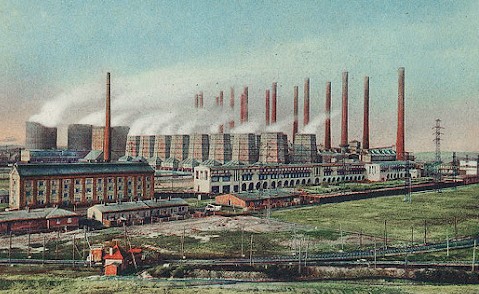
At the time, AEG built the largest steam field in the world.
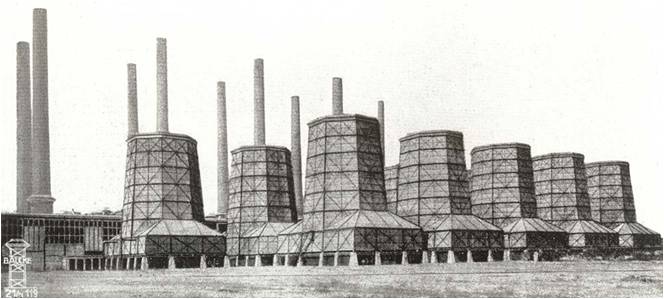
AEG took over the Golpa-Jeßnitz lignite plant back in 1892. Briquettes and bricks were manufactured there. AEG intended to build a power plant at this location. Planning began in 1913. However, the outbreak of World War I delayed the implementation of the construction project. Under the leadership of Georg Klingenberg, the power plant was to be built in Zschornewitz, very close to the Golpa lignite mine. The AEG board of directors pushed ahead with construction. The power plant was already operational in 1915. It was soon expanded to supply neighboring plants, such as the nearby electric nitrate plant and the Berlin electricity works (Bewag), which were located a little further away. With a capacity of 180,000 kVA, nine 100-meter-high chimneys, and eleven 35-meter-high cooling towers, it was a giant of a power plant. AEG laid a 100 kV double high-voltage overhead line over a distance of 130 km to Berlin.
In the 1920s (1920 to 1926), five more turbo sets were added to the eight existing ones. The “forest of chimneys” grew denser as more towers were added.
In 1928, the AEG board decided to expand the power plant once again. The aim was to achieve an output of 430,000 kW. Additional boiler houses, chimneys, cooling towers, and electrical engineering systems were constructed.
The series of power plant expansions continued, for example in 1930 and 1944. However, after the German Wehrmacht surrendered on May 8, 1945, it did not take long before the Golpa-Zschornewitz plant, located in the Soviet occupation zone (SBZ), was increasingly dismantled as part of reparations payments.
In 1970, engineers began expanding the power plant to include a gas turbine power plant and partially converting it to natural gas. A second gas turbine power plant went online in 1979 and a third in 1988. The power plant now had a total output of 597 MW.
After German reunification, it quickly became clear that the outdated steam power plant facilities could no longer be operated economically and had to be shut down quickly, while the three gas turbine power plants were to be kept in reserve at least as peak load reserves until the end of the 1990s. On April 4, 2012, some watched with a touch of sadness as the last two chimneys of the G24 gas turbine power plant were demolished. With that, the Zschornewitz power plant, once built by AEG, became history.